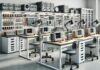
Electronic component assembly tables are used in laboratories, production lines, and specialized workshops, and their design must conform to precise industrial standards and specific usage needs. Considering the sensitivity of electronic components and environmental and human impacts, the design features of these tables should cover all safety, ergonomic, and productivity requirements.
Anti-Static Technology Work Surfaces (ESD)
An anti-stati surface (ESD) is a basic requirement in electronic component assembly tables. Using ESD-safe materials on the work surface prevents electrical discharge and protects sensitive components from damage. In designing these surfaces, conductive materials such as plastic layers and special polymers with suitable surface resistance are used in accordance with international standards like ANSI/ESD S20.20. Moreover, these surfaces are often connected to a grounding wire, providing a discharge path to prevent sparking and unwanted voltage.
Specialized, Non-Direct Lighting
Uniform and controlled lighting is essential in assembling small electronic components. The lighting for assembly tables should use LED lights with a color temperature between 5000 to 6000 Kelvin to create natural light without color distortion. To prevent eye fatigue and shadows, this lighting should be UV-free and designed to be indirect.
Adjustable angle and light intensity lamps are also very useful for precise lighting control across different work surface areas, allowing operators to see even the smallest component details during assembly.
Trays, Holders, and Adjustable Sections
Organizing tools and accessories on assembly tables is designed to provide seamless and quick access to main tools. These sections include impact- and heat-resistant trays, divided drawers, and tool holders. The structure of these tables ensures that sensitive, small tools, such as precision screwdrivers, wire cutters, multimeters, and soldering tools, are easily accessible. Additionally, specific compartments for storing ESD-sensitive components (anti-static bags) are essential in these tables.
Precise Cable Management and Power Distribution System
Cable management and power distribution are of particular importance in assembly tables. To prevent work disruptions and damage caused by scattered cables, the cabling system for assembly tables must be designed according to safety standards. The use of Cable Management Channels and cable clamps keeps equipment and tool cables organized and secure. These tables are usually equipped with ESD-safe sockets, protective fuses, and adjustable voltage and current distribution boxes to safely supply power to tools and devices.
Ergonomic Design and Adjustability
Ergonomics play an important role in the design of assembly tables, enhancing users’ health as well as their productivity. These tables should have height-adjustable legs to accommodate users of different heights. Professional assembly tables are often designed with electric or manual height adjustment mechanisms, allowing users to also adjust the angle of the work surface.
Durable and Resistant Materials
Choosing durable and chemically resistant materials is essential in making assembly tables. The body and surfaces of these tables are usually made of aluminum alloys and stainless steel, making them resistant to chemicals, heat, and impact. Surface coatings are also made of materials like polyurethane and epoxy, which offer high resistance to wear and corrosion, ensuring the tables’ longevity and high quality in tough working conditions.
Customization and Adaptation to Specific Needs
In many cases, production lines or laboratories require customized assembly tables designed according to specific needs. Customization of these tables includes adjusting dimensions, the number and placement of drawers, adding specific compartments and holders for tools, or creating different stations for placing and testing electronic components. These capabilities make assembly tables part of an effective work system that increases efficiency and reduces assembly time.
By adhering to these specialized features and international standards, electronic component assembly tables can not only enhance work precision and safety but also improve productivity and user satisfaction. These designs help operators work in a safe and ergonomic environment without concerns about electrical discharge damage or technical issues.